
Northern Lights from Reykjavík: Cloud Maps, Seasonality and Night Photography
Why cloud breaks matter far more than the KP index alone, when nights grow dark enough and how our free group retry works.
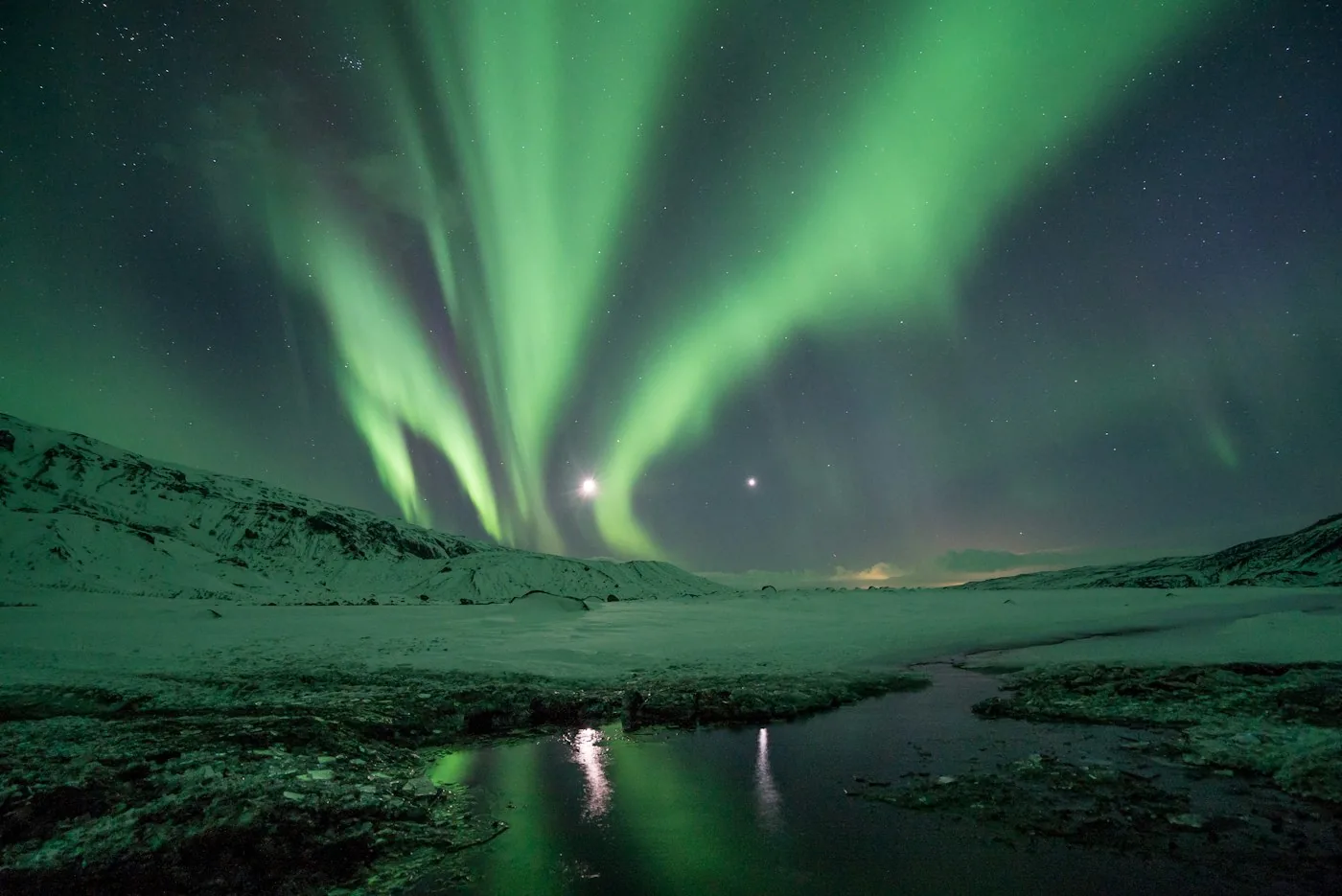
Witnessing the Aurora Borealis in Iceland comes down to a simple equation with demanding local logistics: genuine astronomical darkness, solar-wind particles reaching Earth’s magnetosphere and—the deciding variable across the North Atlantic—an actual break in overhead clouds.
Travel articles often treat high KP geomagnetic numbers as everything, yet anyone guiding winter nights out of Reykjavík knows a calm KP 2–3 under clear rural stars beats a KP 6 buried beneath thick ocean cloud decks every single time.
1. True Darkness Season and Reading Layered Cloud Maps
Because Iceland sits just south of the Arctic Circle, summer skies from May into mid-August stay far too bright for faint night-sky displays [VERIFICAR]. Realistic aurora hunting spans roughly late August or September through mid-April [VERIFICAR], peaking in darkness length from November through February.
Rather than repeating one fixed stop, our 4-hour Northern Lights Hunt (20:30–21:00 pickup at Bus Stop #8 or your hotel) consults live low-, mid- and high-altitude cloud models published by the Icelandic Meteorological Office, Veðurstofa Íslands [VERIFICAR]. Moving 35 to 70 minutes out of city glow toward sheltered valleys—around Þingvellir, Borgarfjörður, Reykjanes or the eastern lowlands—frequently reveals crisp stars when Reykjavík clouds look solid.
2. Naked-Eye Sighting vs. Long-Exposure Night Photography
Understanding dark-adapted vision transforms expectations: human rods read faint light mostly in monochrome at first, meaning gentle auroras frequently begin looking like pale silver-gray or soft green bands shifting across stars before erupting into vivid emerald ribbons and fleeting violet edges during bursts [VERIFICAR].
A steady tripod paired with a fast wide lens (such as f/2.8 or wider), manual infinity focus and multi-second shutter speeds gathers light over several seconds—unlocking richer greens and sky structure than live eyesight processes instantaneously [VERIFICAR]. Our guides offer quiet camera/phone setup help and deliver 15 edited night portraits within 5 days so you spend the night watching the sky rather than fighting tripod dials.
3. Staying Warm During Stationary Sub-Zero Sky Watches
Standing relatively still in an open countryside clearing past 23:00 feels significantly colder than moving along daytime trails, especially when night breezes roll off snowfields. Smart three-layer warmth—merino thermal top and leggings, lofty fleece or down jacket, windproof outer shell, thick wool socks inside roomy boots, ear-covering hat and touchscreen liner gloves beneath insulated mittens—keeps you comfortable long enough for late sky bursts.
We serve hot chocolate and warm tea beside the vehicle while watching sky gauges. Because sub-zero late nights test young children, shared departures (US$300/guest, max 8) welcome ages 6+, whereas private charters (US$1,490 flat up to 8 guests) welcome all ages with pre-requested child seats and complete scheduling flexibility.
4. Clear Free-Retry Terms and -15% Daytime Combo Discounts
Because Northern Lights depend entirely on solar weather and sky gaps, no honest operator guarantees sightings on a single night. Our written policy keeps terms crystal clear: if your tour departs and no aurora appears, you receive 1 complimentary group retry (subject to open seats during your stay or valid for 2 years; non-refundable in cash once operated). If poor cloud cover forces us to cancel pre-departure, you choose free rescheduling or a full 100% refund.
Booking your aurora hunt on one of your earliest evenings in Reykjavík gives maximum room to use a retry if clouds roll in—and combining it with Golden Circle, South Coast or Snæfellsnes applies an instant 15% discount: +US$255/guest shared or +US$1,267 for a 4-hour private departure (covering private vehicle, Reykjavík pickup/drop-off, warm drinks and edited night photos).
5. Why Hunting Auroras in a Max-8 Vehicle Improves Night-Sky Mobility
Whenever a narrow break in Atlantic clouds opens along rural backroads outside Reykjavík city lights, 50-passenger coach groups spend precious minutes loading, turning around in tight pullouts and coping with bright phone screens or stray camera flashes.
Capping departures at 8 guests lets us pivot between dark-sky valleys rapidly if coastal mist shifts, park neatly away from headlight glare and coordinate quiet lighting etiquette so everyone catches uninterrupted night-sky frames.
6. Preparing for Late Return Times and Same-Day Sky Decisions
Because pickups run 20:30–21:00 for roughly 4 hours out in dark countryside clearings, expect drop-off back at your hotel or Bus Stop between roughly 00:30 and 01:00 depending on how far clear skies lie that evening. Enjoy an early dinner ahead of pickup, lay out waterproof boots plus warm thermal layers by the door and keep your phone reachable.
Every afternoon we evaluate updated Veðurstofa cloud maps and solar telemetry before confirming go/no-go status in writing—ensuring you only head out when realistic sky breaks exist, backed by free rescheduling, full cancellation refunds or 1 complimentary group retry.